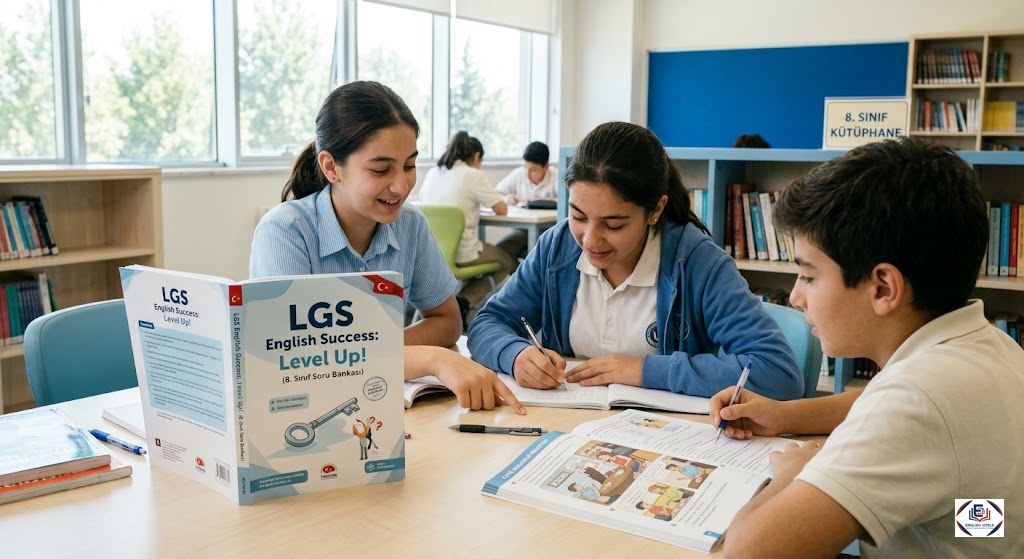
This case study highlights the strategic development of a specialized educational tool designed to bridge the gap between “standardized testing” and “functional communication.”
By targeting the LGS (Liselere Geçiş Sistemi) in Turkiye and equivalent national 8th-grade examination framework, this project demonstrates how targeted material design can improve both exam scores and actual language proficiency.
In the competitive landscape of Turkish secondary education, the 8th-grade English exam serves as a critical benchmark for students’ linguistic abilities. However, a common challenge persists: students often find themselves capable of passing tests but unable to navigate real-world communication. To solve this, a specialized English test book was developed, shifting the focus from rote memorization to Contextual Competence.
The Requirement: Bridging the Practice Gap
The demand for this project was driven by a need for Targeted Rigor. While official school curricula provide the foundation, students often lack exposure to the specific typology of exam tasks. The primary objectives were:
-
Tactical Familiarity: Accustoming students to the specific logic and layout of official exam assignments.
-
Practical Reinforcement: Providing a high-volume practice environment that mirrors the official school program but intensifies the application of its topics.
The Methodology: Communicative Task Design
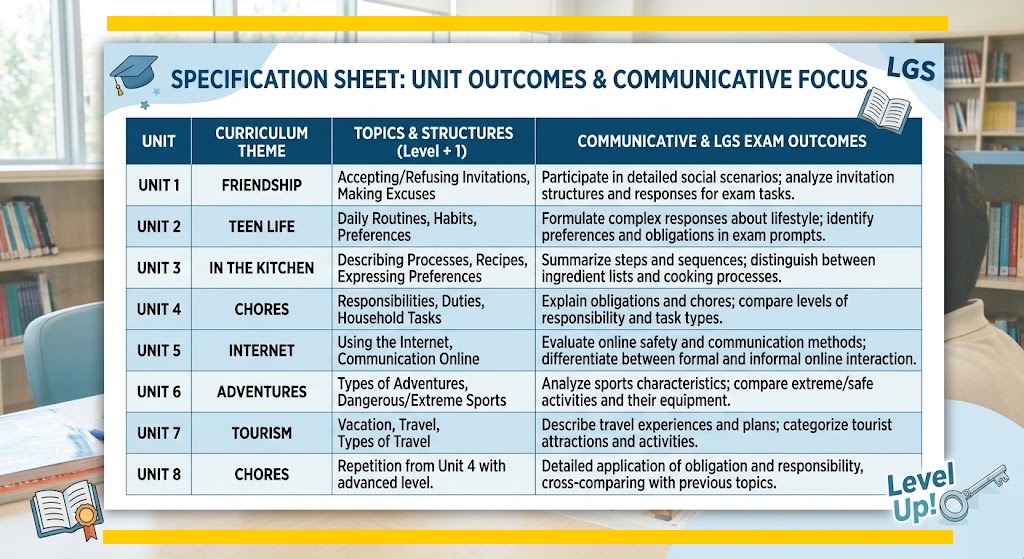
The book was structured strictly according to the formal curriculum, yet it departed from traditional “fill-in-the-blank” methods. Instead, it utilized Functional Situational Tasks.
Each assignment was designed to solve a communicative problem within the contexts identified by the Ministry of Education:
-
Daily Life & Socializing: Negotiating plans in a café.
-
School Environments: Collaborative problem-solving in a classroom setting.
-
Public Interaction: Navigating situations in shops, libraries, or transport hubs.
The “Strategic Edge”: Controlled Difficulty & Authentic Materials
What set this textbook apart was its “Challenge-Up” philosophy. The assignments were developed using authentic English materials—real-world texts, menus, and dialogues—recalibrated to a difficulty level slightly higher than the official exam.
The Logic of “High-Level Readiness”: By training at a “level + 1” difficulty, students developed Cognitive Flexibility. When they encountered the actual exam, the tasks felt manageable and familiar, reducing exam-day anxiety and increasing the speed of comprehension.
Institutional Benefits: The Value for Pre-Ordering Schools
The schools that integrated this textbook into their 8th-grade program realized several strategic advantages:
-
Standardized Quality: Ensuring that all students, regardless of their individual teacher’s style, were exposed to the same high-standard, exam-aligned material.
-
Diagnostic Precision: The book served as a diagnostic tool, allowing teachers to identify exactly which “communicative situations” (e.g., inviting, apologizing, describing) students struggled with most.
-
Competitive Results: By preparing students for a higher level of difficulty, schools saw a measurable uptick in the “Net” scores on mock and official exams, enhancing the school’s academic reputation.
Scalability: A Model for Future Curricula
This experience is highly scalable and serves as a blueprint for other institutions and grade levels:
-
Modular Adaptation: The “Level-Up” framework can be applied to 12th-grade university entrance exams or international benchmarks like IELTS/TOEFL.
-
Digital Integration: The communicative situations in the book can be converted into interactive digital modules or AI-driven speaking bots for remote learning.
-
Cross-Regional Customization: While currently aligned with the Turkish national curriculum, the methodology of using authentic situational English can be localized for any country’s specific exam standards.