Why Memorized Essay Structures Fail Band 7+ And How Process-Based Writing Succeeds
For thousands of candidates preparing for the IELTS exam, the writing section is a persistent stumbling block.
It is common to see ambitious professionals and university applicants plateau at Band 6.0 or 6.5, despite having strong overall English comprehension.
In an attempt to break through this ceiling, many candidates turn to pre-packaged essay templates, rigid formulas, and memorized vocabulary lists found across the internet. While these shortcuts promise a quick fix, they are often the exact reason candidates fail to secure a Band 7 or higher.
Understanding why the template trap fails—and adopting a rigorous, process-based approach to writing—is the key to unlocking your target score.
The Examiner’s Perspective: Why Formulas Trigger Penalties
Experienced IELTS examiners review thousands of essays. They are trained to recognize formulaic writing instantly.
When an essay opens with a cliché-ridden hook or relies on rigid structural connectors that do not fit the nuance of the prompt, a red flag is raised.
Under the official IELTS public descriptor guidelines, high scores in Coherence and Cohesion require logical organization and natural paragraph development. When you force your ideas into a rigid template:
- Logic suffers: The template dictates your structure, forcing you to bend your arguments to fit the box rather than letting the argument dictate the structure.
- Cohesion becomes mechanical: Overusing high-level transitional phrases incorrectly ("consequently," "conversely," "it is irrefutable that") signals a lack of genuine linguistic flexibility.
When form overshadows content, the essay feels artificial, directly impacting your score.
The Cognitive Cost of Rote Learning
The human brain has a limited cognitive load capacity during high-pressure timed exams (such as the 40-minute window for Task 2).
When candidates rely on memorized chunks of vocabulary or complex sentence frames, they spend valuable cognitive energy trying to "insert" those pre-rehearsed elements into the text. This leads to two major issues:
- Grammatical Inaccuracy: Trying to force a complex passive structure or an advanced idiom into an irrelevant context almost always results in unnatural phrasing or grammatical errors.
- Task Response Failures: Memorized introductions and conclusions often fail to directly address the specific sub-questions or nuances of the prompt. Examiners heavily penalize essays that deviate even slightly from the prompt requirements.
The Process-Based Alternative: How to Build Sustainable Fluency
Achieving a Band 7+ requires moving away from static memorization and toward dynamic, process-based writing. Language proficiency at an advanced level is about problem-solving and clear communication, not regurgitation.
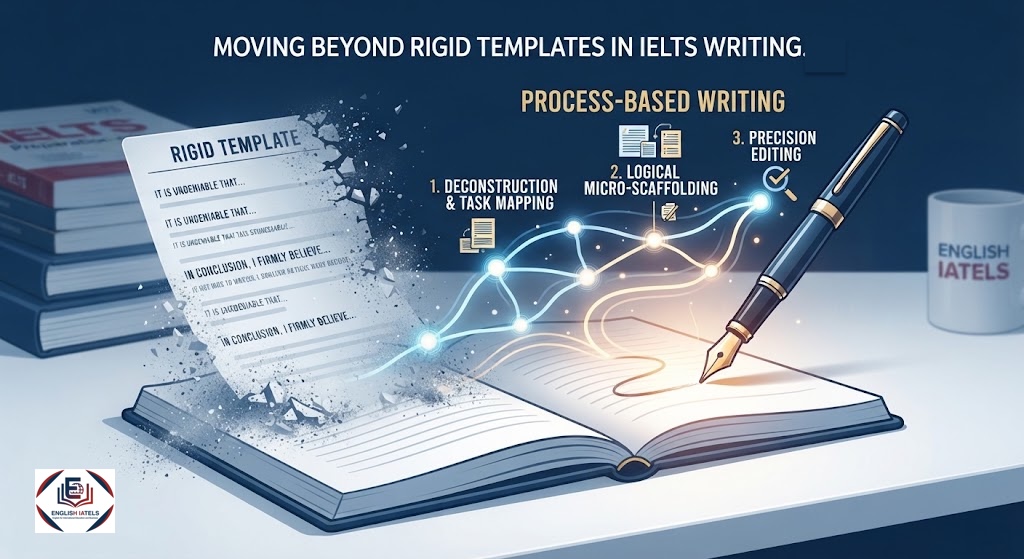
A professional, process-driven approach involves three core stages:
- Stage 1: Deconstruction & Task Mapping (5–7 minutes)Before writing a single sentence, analyze the prompt rigorously. Identify the prompt type (opinion, discussion, problem-solution) and map out your core thesis and supporting arguments. Your vocabulary choices should flow naturally from the topic itself, not from a generic vocabulary list.
- Stage 2: Logical Micro-Scaffolding (25 minutes)Build your paragraphs using clear thematic progression. Each body paragraph should follow a logical arc: topic sentence, explanation, concrete example, and a concluding implication. Transition words should emerge naturally to link ideas, rather than acting as decorative window dressing.
- Stage 3: Precision Editing (5–8 minutes)Reserve the final minutes not to write more, but to check lexical accuracy, correct slips in agreement, and ensure your pronouns and references are clear.
Master the Process with Expert Guidance
Escaping the template trap requires structured practice, objective feedback, and a clear methodology.
At English IATELS, our preparation programs are built on rigorous, process-oriented frameworks designed to develop true academic competence rather than temporary workarounds.
Ready to transform your writing and secure your target score?