In the early years of language acquisition, the medium is the message.
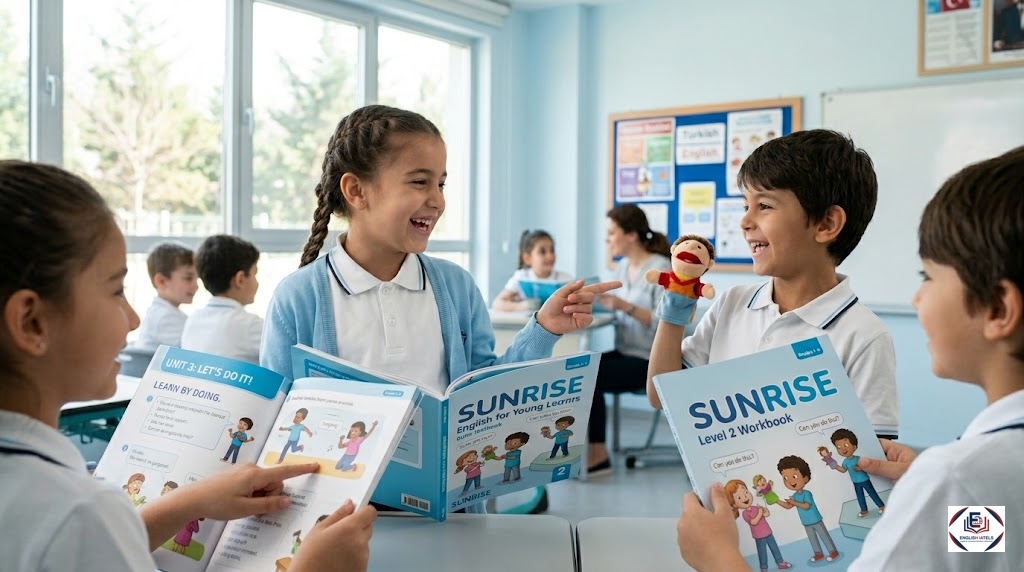
Recognizing that generic, one-size-fits-all textbooks often fail to capture the specific energy and cultural context of young learners, STARTINFORUM developed a pioneering series of English textbooks and workbooks for Grades 1-4.
This project serves as a masterclass in how schools can move beyond “consuming” education to “creating” it.
Pioneering Features: The “STARTINFORUM” Standard
This series was designed using the “Active Language Architecture,” which focuses on the psychological and physical development of children aged 6 to 10. Key features include:
-
The “Early Call to Talk”: Unlike traditional methods that delay speaking, each unit triggers immediate verbal production using the vocabulary learned in the first five minutes.
-
Total Physical Response (TPR) Integration: Learning is linked to physical movement—songs, poems, and rhythmic activities—ensuring that sentence structures are retained in the body’s muscle memory, not just the mind.
-
Dynamic Creativity: The workbook is not a “test book”; it is a creative journal featuring diverse activities that require students to solve meaningful tasks and answer questions that spark curiosity rather than rote repetition.
-
Acoustic Anchoring: Custom-composed songs and poems specifically engineered for pronunciation mastery, making complex phonetics easier for young Turkish learners to mirror.
The Competitive Advantage: Why These Books Outperform
When compared to mass-market international textbooks, this series offers three distinct advantages:
-
Contextual Relevance: While international books use generic examples, this series reflects the local student’s world, making the English feel “near” rather than “foreign.”
-
“Level + 1” Scaffolding: The content is slightly more challenging than standard Ministry requirements, ensuring students remain engaged and ahead of national benchmarks.
-
Seamless Bridge to Grades 5-8: Because the series is designed as a unified 4-year journey, it eliminates the “learning gaps” often found when schools switch publishers between grades.
The Institutional Power Move: Benefits of Proprietary Textbooks
For a school, having its own branded textbook series is a massive strategic asset.
-
Brand Authority: It signals to parents that the school is a “Center of Excellence” that develops its own intellectual property rather than just buying it off the shelf.
-
Curriculum Control: The school can update or modify the content yearly based on student performance data—something impossible with commercial books.
-
Economic Efficiency: Over a 5-year period, owning the rights to the content is significantly more cost-effective than paying high annual per-student licensing fees to global publishers.
Scalability and Suggestions for Other Schools
This experience provides a roadmap for other institutions looking to elevate their English departments. Our suggestions for schools include:
-
Adopt “Learn by Doing” Materials: Shift away from “grammar-first” books toward those that require creative output and physical engagement.
-
Invest in Teacher Training: A textbook is only as good as the teacher. We recommend a “Material-Teacher Synergy” workshop to ensure the book’s communicative features are fully utilized.
-
Consider “Institutional Branding”: Start with a pilot (e.g., Grade 1) and gradually build a full K-12 proprietary series to build long-term academic equity.

Conclusion: The Strategic Benefit of Ownership
When a school starts developing its own textbooks, it stops being a customer and starts being a leader. The Grade 1-4 series by STARTINFORUM has proven that custom-designed materials lead to higher student confidence, stronger teacher alignment, and a more prestigious institutional image.