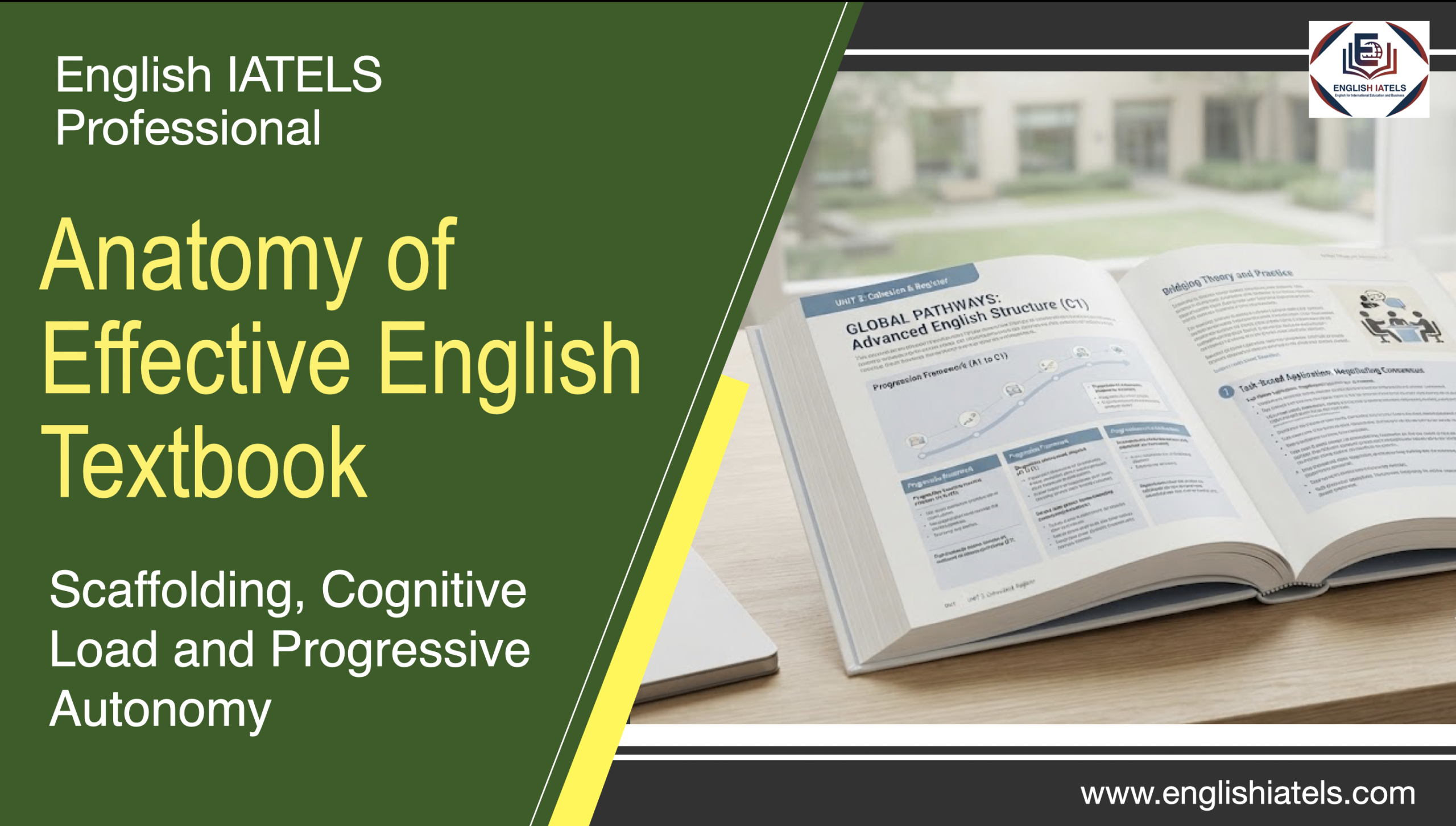
Anatomy of Effective English Textbook
Scaffolding, Cognitive Load, and Progressive Autonomy
In the landscape of English language education, textbooks are often treated as interchangeable commodities. Academic directors and language center managers are regularly inundated with glossy catalogs promising rapid fluency, yet many published materials fall short in actual classroom execution. They either rely on disjointed communicative tasks that lack structural progression or bury learners under dense, unmanageable grammar exercises.
For a textbook series to deliver measurable results—whether in an intensive university preparatory course or a private language center—it must be engineered with scientific rigor.
Developing high-utility materials like the Global Pathways series requires balancing psycholinguistic research, cognitive load theory, and real-world communicative demands.
Understanding the anatomy of an effective English textbook reveals why structural architecture, progressive autonomy, and modular design matter for institutional buyers and curriculum developers.
Science of Material Design: Cognitive Load and Visual Pacing
When designing instructional materials, textbook authors must account for the limited capacity of human working memory. If a page is cluttered with competing visual stimuli, excessive font variations, and unstructured text blocks, learners experience extraneous cognitive load. This distracts them from the actual linguistic objective.
An effective textbook layout utilizes visual structure purposefully:
- Segmented Information Architecture: Content should be chunked into clear, digestible visual modules that guide the eye naturally from input to controlled practice, and finally to autonomous production.
- Optimized Pacing: Pacing is not merely about turning pages; it is about cognitive pacing. Complex syntactic structures must be introduced with adequate white space, graphical schema, and supporting contextual cues to prevent learner fatigue.
- Dual-Coding Integration: Strategic pairing of clean, professional graphics with textual data leverages both visual and verbal processing channels, significantly improving memory retention and long-term lexical retrieval.
Progression Framework (A1 to C1): Structural Recycling
A major structural flaw in many commercial curricula is linear progression without reinforcement—where a grammar point or functional category is taught once and never systematically revisited.
Advanced language proficiency requires a rigorous spiral progression framework across proficiency levels (A1 to C1):
- Foundational Accuracy (A1–A2): Materials must prioritize core syntactic frameworks, high-frequency lexical chunks, and immediate functional utility, establishing automaticity in basic structures.
- Intermediate Expansion (B1–B2): As learners transition into intermediate tiers, the curriculum introduces structural recycling. Previously learned forms are reintroduced at higher cognitive levels—shifting from simple descriptive use to complex subordination, modal nuance, and discourse cohesion.
- Advanced Stylistic Nuance (C1): At the advanced stage, the focus shifts to register flexibility, rhetorical precision, and pragmatic appropriateness, ensuring learners can navigate specialized professional and academic environments effortlessly.
Bridging Theory and Practice: Psycholinguistics Meets Real-World Demands
A textbook can be academically sophisticated yet fail in practice if it ignores real-world communicative ecology. Conversely, books that rely purely on situational dialogues often lack the underlying psycholinguistic scaffolding required for deep learning.
Bridging this gap requires an integrated task design:
- Input-Rich Exposure: Units should begin with authentic or realistically simulated discourse inputs that reflect how language is actually used in professional and academic spheres.
- Noticing and Deconstruction: Exercises must actively guide learners to "notice" structural patterns, pragmatic markers, and collocations within the input before attempting production.
- Task-Based Application: Controlled exercises must transition rapidly into open-ended, goal-driven tasks that mirror real-world challenges—such as synthesizing conflicting data sources, drafting formal executive summaries, or negotiating complex agreements.
Institutional Integration: Seamless Modular Curricula
For academic directors, adopting a new textbook series involves logistical challenges: how will the materials fit into existing term structures, syllabus requirements, and teacher training schedules?
Effective textbook series are built with modular flexibility:
- Scalable Unit Architecture: Each module should be self-contained yet longitudinally connected, allowing schools to adapt pacing to intensive summer courses, standard semester schedules, or corporate upskilling tracks.
- Teacher-Friendly Support Systems: Comprehensive instructor guides, clear lesson arcs, and transparent assessment frameworks minimize preparation friction, enabling educators to deliver high-impact lessons without extensive retraining.
- Institutional Adaptability: Modular curricula allow language centers to mix core language tracks with specialized ESP add-ons, tailoring the student journey to specific market demands.
Equip Your Institution with Proven Curricula
Selecting the right educational materials transforms institutional outcomes, elevates student satisfaction, and drives long-term program growth.
At English IATELS, our publication catalog—including the Global Pathways series and specialized preparation modules—is engineered to meet the highest standards of academic rigor and practical utility.
Please feel free to contact our managers to inquire about:
- Our Publication Catalog & Curriculum Series
- Examination Copies for Academic Evaluation
- Institutional Partnerships and B2B Distribution and other questions.